Why the upstairs is cold, and why the attic is usually the answer
The room you cannot heat and the room directly under the attic are almost always the same room.
August 31, 2026 · 3 min read

It is one of the most common calls we get, and it almost always arrives phrased as a heating problem. The upstairs will not hold temperature. The bedroom over the garage is unusable in January. The thermostat says one thing and the top of the house says another.
Occasionally that really is a heating problem. Far more often the heat is arriving perfectly well and then leaving through the ceiling.
Warm air goes up, and it takes your money with it
Heat moves upward. That is not a metaphor, it is the whole mechanism. Whatever you pay to warm collects at the top of the building and then works on the weakest surface it can find. In most houses the weakest surface by a wide margin is the attic floor.
So the upstairs is not cold because the heat never got there. It is cold because the heat got there, kept going, and is now warming the underside of your roof deck and, eventually, the sky. The rooms below are buffered by the rooms above them. The top floor has nothing above it except the problem.
Why attics are so often done badly
Attics are genuinely difficult, and that difficulty is why so many of them are half insulated. Insulation up there has to work around joists, around wiring, around ductwork, around plumbing stacks and around whatever the last three owners stored on the boards. Anything cut to size has to be cut around all of it, and every cut is a gap.
A batt that has been trimmed to fit past a cable and then pushed back into place is not performing at its rated value any more. Neither is one that has been compressed under a plywood storage deck. The material is still there, so it looks insulated. It is not behaving as though it is.
This is why the fix so often involves changing the product rather than adding more of the same. Something that expands to fill, or something blown in loose to a consistent depth, does not have the gap problem that anything cut to size has by construction.
Depth is the job
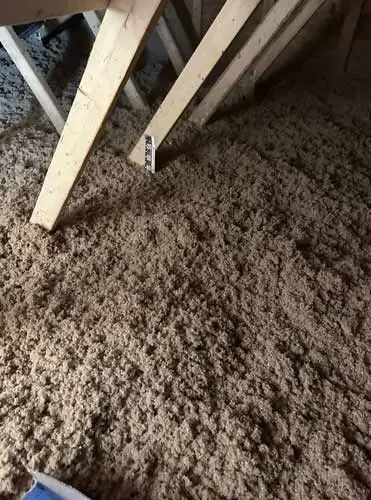
With blown-in cellulose in particular, depth is not a detail of the job. Depth is the job. Coverage that reads well at the hatch and thins out over the far corner is a very ordinary way for an attic to underperform, and it is invisible from the only place most people ever look.
We install to a measured depth and check it with a rule before packing up, rather than judging it by eye. It is a small discipline and it is the difference between the number you were quoted and the number you actually own. If a corner is short, that corner is exactly where next winter's heat is going.
What to look at before you call anyone
- Put your head through the hatch and look at the far corners, not the area near the opening. The corners are where work gets abandoned.
- Look for insulation that is visibly compressed, especially under any boarded storage area.
- Look for daylight, and for anything that passes through the ceiling plane without being sealed around.
- Notice whether the depth looks consistent across the whole floor or whether it varies as you look further out.
- If there is a room over a garage or a porch, treat it as its own problem. It has cold on more sides than a normal room does.
The honest expectation
Air sealing and insulating an attic properly is not a cosmetic improvement. Customers tend to describe the change as immediate, and one told us the difference before and after was drastic, which is the word people reach for when a house stops behaving the way it always has.
What we will not do is quote you a figure for what you will save. That number depends on your building, your fuel, your thermostat habits and the weather, and anybody who gives you a confident percentage before looking at your attic is guessing. What we will do is come and look, tell you what is actually up there, and give you a real number for the work.
Correct Energy Spray Foam, (518) 817-2376
Call (518) 817-2376More articles
Closed-cell or open-cell: which one your building actually wants
Two products that get talked about as one. They behave differently, and the difference decides where each belongs.
Cold floors are not a flooring problem
You can put a rug over it, but the rug is not the thing that is cold.